Skip to content
Back to home
Products

Products, solutions and working method for industrial operations.

This page brings together the AUTEN suite, the types of problems it solves, and the method used to turn scope, engineering and deployment into traceable delivery.

Solutions

The acronym matters less than what changes on the floor.

Every application starts from the problem, not the label. Architecture, logic, HMI, tests and sign-off come with criteria recorded.

SOL-BTPROC
ISA-88

Batch & Process

When two identical batches don't end up the same, the problem is rarely the operator. It's in how recipe, equipment and phase were modeled. ISA-88 becomes a living standard, not a project appendix.

  • Recipes and phases
  • Lot trail
  • Validated sequences
SOL-SCADA
Operation

SCADA & HMI

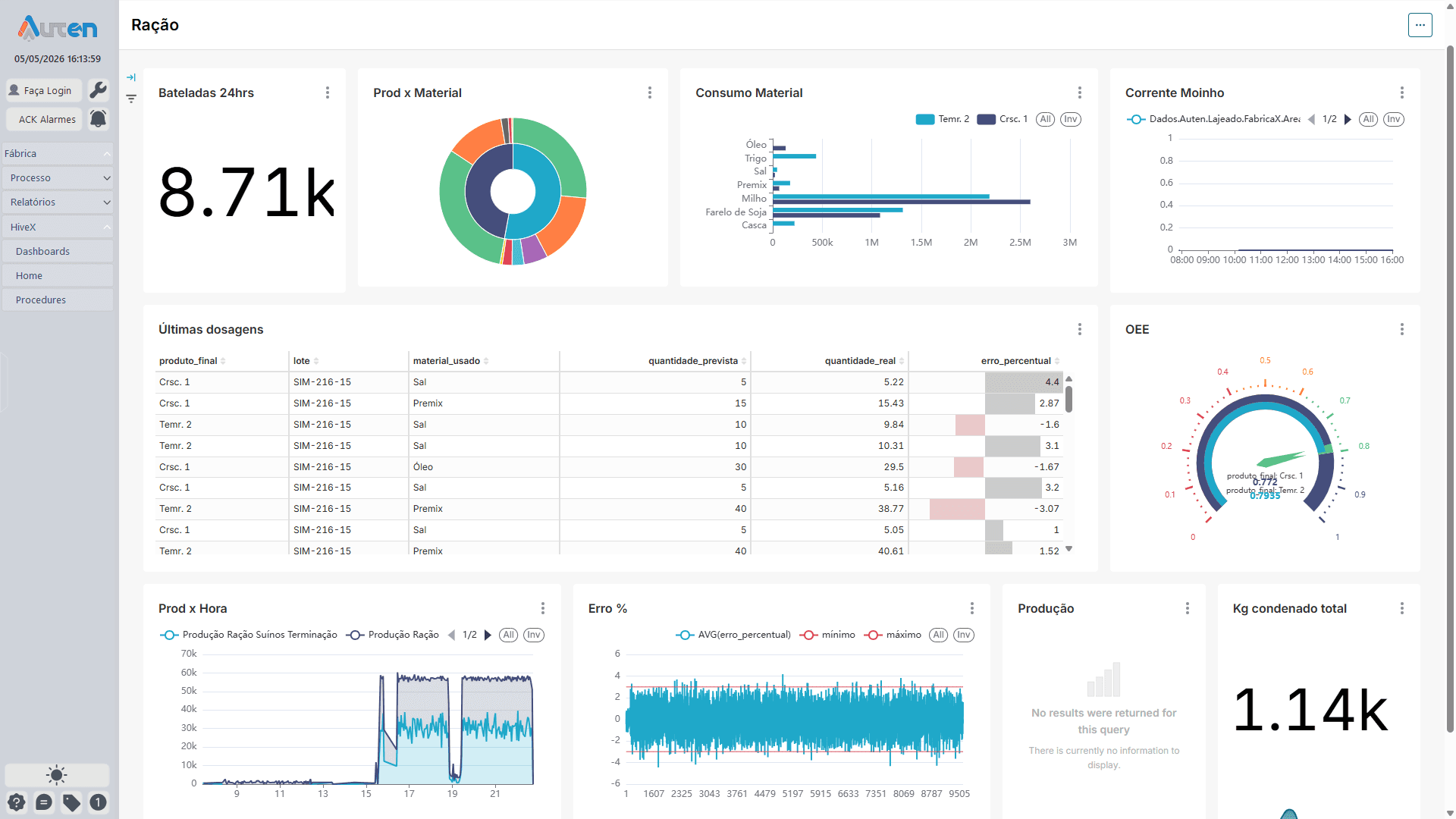
When the operator switches between five screens and still can't explain what stopped, the supervisor turned into noise. We standardize navigation, alarms and diagnostics so operations can see state, sequence and cause.

  • Role-based screens
  • Actionable alarms
  • Shift diagnostics
SOL-I40
MES/ERP

Industry 4.0

Industry 4.0 starts when data leaves the PLC with context and reaches the ERP without losing meaning. The next step is getting people, machines, systems and AI to decide on the same data, with more predictability and less waste.

  • SQL and APIs
  • Reliable KPIs
  • Orders and events
SOL-CTRL
PLC/DCS

Process control

Before talking about advanced control, it's worth asking if the base loop is actually tuned and the interlock matches real risk. This less glamorous work is where operation earns stability.

  • Stable loops
  • Reviewed interlocks
  • Assisted startup in the field
Catalog

AUTEN suite — products for the full automation lifecycle.

Eight integrated products covering the path from initial diagnosis to ongoing sustainment. Click a product for objectives, deliverables and gallery.

Method

Five phases. Each closes with criteria on record.

No improvisation between scope and go-live. What reaches production was discussed, tested and accepted with evidence.

  1. Phase
    01

    Planning

    Scope, architecture and decision criteria defined before any line of code. What enters the build was already discussed with the people who operate and the people who maintain.

    Deliverable

    Architecture, risks, assumptions and acceptance criteria.

  2. Phase
    02

    Development

    Engineering on top of patterns and libraries already validated in other projects. Logic, screens and integrations come with conventions readable by the internal team and replicable across plants.

    Deliverable

    Software, screens, technical documentation and test plan.

  3. Phase
    03

    Testing & validation

    Tests with agreed criteria, not a generic checklist. Each failure becomes a recorded adjustment, with evidence that holds up the acceptance.

    Deliverable

    FAT/SAT evidence, adjustments and acceptance record.

  4. Phase
    04

    Deployment

    Commissioning in the field with people available across the startup shifts. Training by role, because operations, maintenance and engineering need different readings of the same system.

    Deliverable

    Assisted go-live, checklist and operational handover.

  5. Phase
    05

    Continuity

    Structured support after go-live. Criticality-based SLAs, KPIs followed up and an evolution plan, so the plant stops relying on individual heroics.

    Deliverable

    Support routine, history and evolution plan.